Do You Have Strategic Competencies…?


sam muchai blog

Imagine that you are holding a box that contains something of great value to your customers and no one else has it or can even copy it with-ought great difficulty.

Do you think you could make any money with it?of course you could! That is the holy grail in business -to have something that is both valuable and unique,something that customers really want and makes you different from other competitors.We call such a things Strategic competencies-and you should find yours.

But strategic competencies are not like many other things in business.You cant go anywhere and buy a strategic competency,the way you can purchase a machine,acquire a patent,or even hire an employee.That is because true strategic competencies are different.They are intellectual assets,not physical assets,and they are the hidden drivers behind most successful modern companies.

Look at it this way.The more intellectual content you have in what you do,the better you can perform.The more you can know about designing your services,or making your product, or delivering it to your customers,tastes,or advertising it,or anything else,the more likely it is that you already have strategic competency.You have just got to find it.If you can put your special know-how(which is better and different) into your services or products,you will have a winner.But first you have got to find that unique and valuable knowledge..Keep going.

Later in the week we look at the mix of Strategic Competency…

Uncategorized , , , , , , , , , , , , , , , , , , , , , , , , , , , , , ,

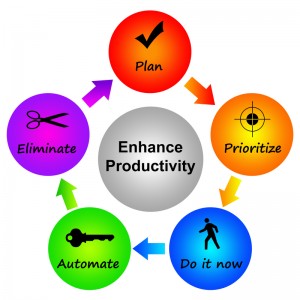
Five quick tips to enhance your productivity…

1. Plan – Your plan identifies the who, what, when and where of closing the gap between where you are and where you want to be.
2. Prioritize – Sequence is everything. You don’t put your pants on first and then your underwear or you shoes on first and then your socks. Knowing the order of what to do keeps things in order when you’re doing them.

sam muchai how-to-be-productive-300x300
3. Do It Now – The fastest route to getting to where you want to go is starting now, because any delays in starting equals delays in arriving.
4. Automate – Don’t do manually what you can do automatically. Look to leverage technology and get acceleration from automation.
5. Eliminate – Prune of your weakest activities and the nonessential task. Separate what’s nice to do from what you need to do.

Have a productive month of April…

Uncategorized , , , , , , , , , , , , , , , , , , , , , , , , , , ,

When The Infrastructure Shifts, everything Rumbles….

jeff-bezos-founder amazon

jeff-bezos,founder- amazon

We are witnesses to one of the most significant shifts in human history. Peter Drucker, one of the greatest management thinkers of our time puts it this way:

“In a few hundred years, when the history of our time is written from a long-term perspective, it is likely that the most important event that those historians will see is not technology, not the Internet, not e-commerce. It is an unprecedented change in the human condition. For the first time- literally-substantial and rapidly growing numbers of people have choices.

For the first time, they will have to manage themselves.  “And society is totally unprepared for it.”

To understand the core problem and the profound implications of Drucker’s prophetic statement, we must look first at the context of history –namely, the five ages of civilization’s voice:

first, the Hunter and Gatherer Age;

second, the Agricultural Age;

third, the Industrial Age;

fourth, the Information/Knowledge Worker Age;

and finally, an emerging Age of Wisdom.

Imagine for a moment that you take a step back in time and are a hunter and a gatherer of food. Each day you go out with a bow and arrow or stones and sticks to gather food for your family. That’s all you’ve ever known, seen and done to survive. Now imagine someone comes up to you and tries to persuade you to become what he calls a “farmer.” What do you think your response would be?

You see him go out and scratch the earth and throw little seeds into the ground and you see nothing; you see him watering the soil and removing weeds and still you see nothing. But eventually you see a great harvest. You notice his yield as a “farmer” is fifty times greater than yours as a hunter and gatherer, and you are considered one of the best. What would you do? You would likely say to yourself, “Even if I wanted to, I couldn’t do that. I don’t have the skills and I don’t have the tools.” You just wouldn’t know how to work that way.

Now the farmer is so productive that you see him making enough money to send his kids to school and give them great opportunities. You are barely surviving. Little by little, you’re drawn to go through the intense learning process of becoming a farmer. You raise your children and grandchildren as farmers. That’s exactly what happened in our early history. There was a downsizing of hunters and gatherers of over 90 percent, they lost their jobs.

Several generations pass, and along comes the Industrial Age. People build factories and learn specialization, delegation and scalability.They learn how to take raw materials through an assembly line with very high levels of efficiency. The productivity of the Industrial Age goes up fifty times over the family farm. Now if you were a farmer producing fifty times more than hunters and gatherers and all over sudden you see an industrial factory rise up and start outproducing the family farm by fifty times, what would you say? You might be jealous, even threatened. But what would you need to be a player in the Industrial Age? You would need a completely new skill-set and tool-set. More importantly, you’d need a new mind-set – a new way of thinking. The fact is that the factory of the Industrial Age produced fifty times more than the family farm, and over time, 90 percent of farmers were downsized. Those who survived in farming took the Industrial Age concept and created the industrialized farm. Today, only 3 percent of the people in the United States are farmers, who produce most of the food for the entire country and much of the world.

Do you believe that the Information /Knowledge Worker Age we’re moving into will outproduce the Industrial Age fifty times? I believe it will.We’re just barely beginning to see it. It will outproduce it fifty times-not twice, not three or ten times, but fifty. Nathan Myhrvold, former chief technology officer at Microsoft, puts it this way: “The top software developers are more productive than average software developers not by a factor of 10X or 100X or even 1000X but by 10,000X.”

Quality knowledge work is so valuable that unleashing its potential offers organizations an extraordinary opportunity for value creation. If that is true, just think of the value of unleashing the potential of your children. Knowledge work leverages all of the other investments that an organization or a family has already made. In fact, knowledge workers are the link to all of the organization’s other investments. They provide focus, creativity, and leverage in utilizing those investments to better achieve the organization’s objectives.

Do you believe the Knowledge Worker Age will eventually bring a downsizing of up to 90 percent of the Industrial Age workforce? I believe it. Current outsourcing and unemployment trends are just the tip of the iceberg. In fact, these trends have become a very hot political issue. But the reality is that much of our losses in Industrial Age jobs have less to do with government policy and free trade agreements than they do with the dramatic shift in our economy to the Knowledge Worker Age. Do you think it will be threatening to today’s workforce to learn the new mind-set, the new skill-set, and the new tool-set of this new age? Imagine what it will take. Imagine what it will take for you – what it will take to be a player in this new era. Imagine what it will require of your organization!

A shift to Wisdom Age – Where individually you make choices combined with Knowledge and acquired skills every second…

Your Mind is your greatest Asset…Protect it and make great use of it…Sam Muchai

Good Luck


Uncategorized , , , , , , , , , , , , , , , , , , , , ,

Efforts Can Change Things…


sam muchai insights

One of the fascinating aspects of business and organized movements is that there is correlation between the passion and effort that people bring to a project and the outcome.

This isn’t true for the weather.Accept the days forecast for what it is,because there is nothing you can do about it.But market share,innovation,negotiations,human relations-they can be shifted with the right sort of insight and effort.

The challenge is in understanding when our efforts cant possibly be enough,and in choosing projects and opportunities that are most likely to reward the passion we bring to the situation.

If there is no way in the world you can please that customer with reasonable amount of effort,perhaps its better to accept the situation than it is to kill yourself trying(and failing) to change that persons mindset.

There is a difference between passively accepting every element of your environment (and thus missing opportunities to exploit) and being wise enough to leave the unchangeable alone,or at least work around it.

Remember…Efforts can change things…

Good luck..

Uncategorized , , , , , , , , , , , , , , , , , , , ,

Color Influence On Your Brand Recognition…


Human mind avoids complexity and yearns for simplicity;

Why is color increasingly important to a brand’s storyline?
Color increases brand recognition up to 80 percent. And people make a subconscious judgment within 90 seconds. Researchers estimate that anywhere between 62 percent and 90 percent of that assessment is based on color alone. A color that suits your brand—one that quickly becomes a signature brand cue—can make the difference between a company,Individual or at this time;a political party, that seems friendly or indifferent, or one that seems cutting edge or out-of-step.

Do most brands use color as a signature cue?
Many brands have invested billions in color, even if they don’t reference it. Coca-Cola may not call out its bright red to consumers, but it is recognized all over the world.

How does color fit in to a brand’s personality?
Whether we are conscious of it or not, colors have enormous emotional impact. They say babies cry more often in yellow rooms, for example. Dangerous criminals are more subdued when housed in pink rooms. It can even affect performance: Weight lifters put up bigger numbers in a blue room, for instance.

The right colors have a direct impact on how people feel and behave.

Test,Try and Explore ..

Good Luck..

Uncategorized , , , , , , , , , , , , , , , , , , , ,

7 Steps To Building Commanding Confidence…

how to build confidence
How to be confident and consistently move your life forward is a critical skill to have.
And yes, confidence is a skill, not some inborn predestined personality trait.Confidence is a skill you can build.
Everyday, all of us are on the front lines of life fighting for progress. Of course how we define progress varies from person to person, company to company and even country to country.Progress can be defined as peace, prosperity, position, power or people united for a common cause.
However you define progress, wherever the battle lines have been drawn, there is one sure-fire conquering force that can help you to carry the highest probability of victory and that force is called: CONFIDENCE!
The need of confidence is not the mystery. The mystery seems to be in how do you build and sustain an unwavering confidence that does not allow you to concede defeat even in the face of multiple failures.
A confidence that helps you to know that success is imminent even while standing on the edge of failure.
Here Are The 7 Steps To Building Commanding Confidence
1. Mental Self-Defense – Defend your mind (What weighs you down?)
  • Addictions
  • Anger
  • Hopelessness
  • Resentment
  • Self-Pity
  • Confusion
  • Doubt
2. No Huddle Offense – Rapidly take action to move your life forward (What lifts you up?)
  • Caring (Who do you care about?)
  • Humor (What makes you laugh?)
  • Purpose (What drives you?)
  • Generosity (Who do you like to give to?)
  • Detachment (What makes you feel free?)
3. Past-Tense Tension – Let the past be the past (What blocks you from your past?)
  • Complaining (Disagreeing with what was that has created what is.)
  • Blaming (Yourself, your past, your parents, your partner, who?)
  • Controlling (Trying to control the uncontrollable, like your past or other people from your past)
  • Arguing (With your past or with people that should remain in your past)
  • Externalizing (Feeling like a victim of past and present circumstances.)
4. Manage The Suspense – Manage your moods and emotional fears and uncertainty (Digg a trench in your purpose and a beachhead on your mission) The why
  • I’m doing this because I want;
    • To inspire people to…
    • To create new ways of…
    • To understand…
    • To help implement…
    • To do the most good to/for…
    • To discover new…
    • To solve problems for…
    • To unravel life’s mysteries around…
    • To build, organize and plan a…
    • To be a master of…
5. Know The Expense – What does lack of confidence cost you today? (What will it cost you going forward?)
  • Abundance & Prosperity
  • Purpose
  • Authenticity
  • Growth
  • Excellence
  • Leadership
  • Health
6. Have A Future Sense – Lean into your future not into your past (What themes are pulling you forward?(
  • Adventure
  • Spiritual Growth
  • Travel
    • One of mine used to be “Treasure Hunter” I was constantly looking for the treasure in myself and others and no automatically their would be great challenges in that journey going forward.
7. Condense The Course – Reduce your big picture dreams and goals into short term doable daily action steps
  • What can be done now?
  • What is to be done next?
  • Next actions?
  • Next items?
  • Use checklist, daily planning and project management methods
  • Do mini projects
  • Take micro steps to make progress and build momentum
  • Celebrate every completed action and step taken to encourage yourself and others.

There you have them…Good luck..

Uncategorized , , , , , , , , , , , ,

Howe To Overcome Fear and Doubt…

sam muchai blog

Doubts become dictators when we don’t subdue them and destroy them.

Doubts pollutes the air you breathe and poison the blood …and to make matters worst, doubt pals around with it’s closes friend called fear.

Fear weaves a cocoon for you to live in that isolates you from your dreams.

One of the greatest fears known to man is the fear of loss. Well, let me tell you… you, I and all of use will always lose something. But let me sharpen this image for you by saying this;

Choose what you will lose…

1). Lose your fear and live your life

or 2). Lose your life because of your fears.

Combined together, when your faith is caught between the pincers of doubt and fear a bright future disappears in the smog of despair, hope morphs into hopelessness and we resort to coping strategies as opposing to advancing and conquering strategies.

Let me add that both doubt and fear are two-faced double-crossing liars.

By that I mean they offer you the illusion of safety by staying where you are and not taking risk and chances and at the same time it sneaks up behind you silently and slices the arteries of your life as you bleed out all your hope and possibilities.

Both doubt and fear are vampires that tempt you to surrender your soul to an abyss of nothingness.

Okay so check this out, the big illusion here is that doubt and fear have a grip on you… oh no my friend, in actuality it is you that have grasped the chains of fear and have sipped the forbidden wine of doubt.

The fastest way to detox from doubt and overcome fear is to understand it’s not over you or under you it’s a manufactured experience inside of you.

You no longer have to go around drunk on doubt and intoxicated on fear. Being a doubtoholic can be a thing of the past.

Release it like you would a handful of hot coals and just get on with your life.

I know that sounds easier said than done, but the way to make it easier done than said is to loose yourself from the unhealthy addiction to fear and the irreconcilable differences your dreams have with your doubts.

It’s a decision that takes as long or as short as you decide it will take.

Give yourself permission to breathe again, to live again.

It’s time for you to come out of the shadows of fear and rise out of the ash of doubt by flapping the wings of faith and allowing the winds of hope to assist you in soaring higher and higher.

Make the decision now to let go of your fears and doubts for the future.

You can look forward to your future with hope and confidence. If today or tomorrow brings joy, welcome it. If it brings challenges, know that you have the strength and fortitude to conquer them.

No longer a coward, you’re courageous and as a result, you are free from the jaws of fear and clutches of doubt.

Avoid fretting over what is to come. And certainly stop fretting over what has already passed you by. Instead, bury the hatchet with your past and seek solutions going forward as you focus on what YOU CAN DO to experience the life you desire.

One thing you can do is to live “IN”  the moment, not simply “FOR” the moment. That means you maximum your impact today with the full understanding of how it influences your tomorrow.

When you are focused on the now, the right here, the today… in this moment, there is no past to imprison you and no uncertain future to frighten.

You can then savor the seconds that tick by while being mindful of the minutes that roll on as discover, tap into and maximize the power of ever hour available to you.

In wrapping this up, let me encourage you to have a “flexible focus”. That means you’re focused intensely on where you’re going, but flexible as to how you get there.

This is necessary because challenges are a natural part of the terrain in life. Understanding the terrain and navigating it is a primary key to success.

Today, you can choose to be carefree (but not careless), Leave the past in the tomb of yesterday, …allow the birth of tomorrow to come in it’s due time and for now discover the beauty and the power available for you today.

Until next time, remember… don’t let you doubts control your future, control the future of your doubts.

Good luck…

Uncategorized , , , , , , , , , , ,

Gifts as a Signal of Surplus…

sam muchai blog

Its difficult to be generous when you are hungry. Yet being generous keeps you from going hungry.Hence the conflict.

A business coach writes and gives away a two hundred-page e-book jammed with useful tips and secrets.Everything he knows,online,for free.Is this generous or stupid? Is there an easier way to make it clear that he has wisdom to spare?

Gifts not only satisfy our needs,they also signal to the world that we have plenty more to share.This perspective is magnetic.The more you have in your cup,the more likely people are to want a drink.

If I meet you at a party,I hope you will ask me for a free marketing advice.Am always amazed that people are willing to listen and happy to share.

The act of giving the gift is worth more than to receive.

Keep up the action…

Uncategorized , , , , , , , , , , ,

7 Things Extraordinary People Say Every Day…

They’re small things, but each has the power to dramatically change someone’s day. Including yours.

sam muchai dolphins group blog

“Here’s what I’m thinking.”

You’re in charge, but that doesn’t mean you’re smarter, savvier, or more insightful than everyone else. Back up your statements and decisions. Give reasons. Justify with logic, not with position or authority.

Though taking the time to explain your decisions opens those decisions up to discussion or criticism, it also opens up your decisions to improvement.

Authority can make you “right,” but collaboration makes everyone right–and makes everyone pull together.

“I was wrong.”

I once came up with what I thought was an awesome plan to improve overall productivity by moving a crew to a different shift on an open production line. The inconvenience to the crew was considerable, but the payoff seemed worth it. On paper, it was perfect.

In practice, it wasn’t.

So, a few weeks later, I met with the crew and said, “I know you didn’t think this would work, and you were right. I was wrong. Let’s move you back to your original shift.”

I felt terrible. I felt stupid. I was sure I’d lost any respect they had for me.

It turns out I was wrong about that, too. Later one employee said, “I didn’t really know you, but the fact you were willing to admit you were wrong told me everything I needed to know.”

When you’re wrong, say you’re wrong. You won’t lose respect–you’ll gain it.

“That was awesome.”

No one gets enough praise. No one. Pick someone–pick anyone–who does or did something well and say, “Wow, that was great how you…”

And feel free to go back in time. Saying “Earlier, I was thinking about how you handled that employee issue last month…” can make just as positive an impact today as it would have then. (It could even make a bigger impact, because it shows you still remember what happened last month, and you still think about it.)

Praise is a gift that costs the giver nothing but is priceless to the recipient. Start praising. The people around you will love you for it–and you’ll like yourself a little better, too.

“You’re welcome.”

Think about a time you gave a gift and the recipient seemed uncomfortable or awkward. Their reaction took away a little of the fun for you, right?

The same thing can happen when you are thanked or complimented or praised. Don’t spoil the moment or the fun for the other person. The spotlight may make you feel uneasy or insecure, but all you have to do is make eye contact and say, “Thank you.” Or make eye contact and say, “You’re welcome. I was glad to do it.”

Don’t let thanks, congratulations, or praise be all about you. Make it about the other person, too.

“Can you help me?”

When you need help, regardless of the type of help you need or the person you need it from, just say, sincerely and humbly, “Can you help me?”

I promise you’ll get help. And in the process you’ll show vulnerability, respect, and a willingness to listen–which, by the way, are all qualities of a great leader.

And are all qualities of a great friend.

“I’m sorry.”

We all make mistakes, so we all have things we need to apologize for: words, actions, omissions, failing to step up, step in, show support…

Say you’re sorry.

But never follow an apology with a disclaimer like “But I was really mad, because…” or “But I did think you were…” or any statement that in any way places even the smallest amount of blame back on the other person.

Say you’re sorry, say why you’re sorry, and take all the blame. No less. No more.

Then you both get to make the freshest of fresh starts.

“Can you show me?”

Advice is temporary; knowledge is forever. Knowing what to do helps, but knowing how or why to do it means everything.

When you ask to be taught or shown, several things happen: You implicitly show you respect the person giving the advice; you show you trust his or her experience, skill, and insight; and you get to better assess the value of the advice.

Don’t just ask for input. Ask to be taught or trained or shown.

Then you both win.

“Let me give you a hand.”

Many people see asking for help as a sign of weakness. So, many people hesitate to ask for help.

But everyone needs help.

Don’t just say, “Is there anything I can help you with?” Most people will give you a version of the reflexive “No, I’m just looking” reply to sales clerks and say, “No, I’m all right.”

Be specific. Find something you can help with. Say “I’ve got a few minutes. Can I help you finish that?” Offer in a way that feels collaborative, not patronizing or gratuitous. Model the behavior you want your employees to display.

Then actually roll up your sleeves and help.

“I love you.”

No, not at work, but everywhere you mean it–and every time you feel it.

Nothing.

Sometimes the best thing to say is nothing. If you’re upset, frustrated, or angry, stay quiet. You may think venting will make you feel better, but it never does.

That’s especially true where your employees are concerned. Results come and go, but feelings are forever. Criticize an employee in a group setting and it will seem like he eventually got over it, but inside, he never will.

Before you speak, spend more time considering how employees will think and feel than you do evaluating whether the decision makes objective sense. You can easily recover from a mistake made because of faulty data or inaccurate projections.

You’ll never recover from the damage you inflict on an employee’s self-esteem.

Be quiet until you know exactly what to say–and exactly what affect your words will have.


Uncategorized , , , ,

12 Great Motivational Quotes for 2013…

sam muchai blog dolphins group

At the start of every year, I create a list of quotes to guide and inspire me for the next 12 months. Here are the quotes I’ve selected for 2013:

1. “Cherish your visions and your dreams as they are the children of your soul, the blueprints of your ultimate achievements.”
Napoleon Hill

2.  “The key to success is to focus our conscious mind on things we desire not things we fear.”
Brian Tracy

3.   “Success is getting what you want. Happiness is wanting what you get.”
Dale Carnegie

4.  “Obstacles are necessary for success because in selling, as in all careers of importance, victory comes only after many struggles and countless defeats.”
Og Mandino

5. “A real decision is measured by the fact that you’ve taken a new action. If there’s no action, you haven’t truly decided.”
Tony Robbins

6.”If you can’t control your anger, you are as helpless as a city without walls waiting to be attacked.”
The Book of Proverbs

7. A mediocre person tells. A good person explains. A superior person demonstrates. A great person inspires others to see for themselves.”
Harvey Mackay

8. “Freedom, privileges, options, must constantly be exercised, even at the risk of inconvenience.”
Jack Vance

9.”Take care of your body. It’s the only place you have to live.”
Jim Rohn

10. “You can have everything in life you want, if you will just help other people get what they want.”
Zig Ziglar

11.”The number of times I succeed is in direct proportion to the number of times I can fail and keep on trying.”
Tom Hopkins

12. “You have everything you need to build something far bigger than yourself.”
Seth Godin

Uncategorized , , ,